Last Month In Review
October was a month of contrasts—a tale of soaring markets against a backdrop of political gridlock. Global equities continued their upward march, with the S&P 500 gaining roughly 2.3% and the Nasdaq surging nearly 4.7%, marking yet another series of record highs. Technology and AI-driven sectors were the clear protagonists, fueling optimism even as headlines warned of turbulence. Investors watched nervously as the U.S. government entered its longest shutdown in history, stretching over 40 days, casting shadows over economic data and consumer confidence. Yet, markets seemed to shrug off the drama, buoyed by strong earnings and another rate cut from the Federal Reserve. This resilience begs the question: Are we witnessing strength or complacency? [schroders.com], [ccmg.com], [markets.fi…ontent.com]
The Government Shutdown’s Ripple Effect
The shutdown wasn’t just a political spectacle—it had real economic consequences. Nearly 900,000 federal employees were furloughed, and millions worked without pay, while critical services stalled. The Bureau of Labor Statistics halted jobs and inflation reports, leaving policymakers and markets “flying blind.” Economists estimate the shutdown shaved up to 0.2 percentage points off annualized GDP growth for each week it persisted, with consumer sentiment plunging to its second-lowest reading since 1978. While Wall Street largely looked past the disruption, Main Street felt the pinch, especially lower-income households reliant on federal programs. This disconnect between market exuberance and economic strain is a theme investors cannot ignore as we approach year-end. [thestreet.com], [jpmorgan.com], [validusrm.com]
Employment and Economic Positioning
Labor market signals grew murky in October. With official data delayed, alternative sources painted a picture of fragility. ADP reported a modest gain of 42,000 private-sector jobs, a rebound from prior months but far below early-year trends. Wage growth flattened, and layoffs hit their highest October level since 2003. Analysts expect unemployment to edge toward 4.7% in 2026, driven by tariff-related pressures and corporate cost-cutting. Consumer spending remains the economy’s lifeline, but cracks are forming—holiday spending intentions dipped, and confidence waned. The Fed’s dual mandate faces a delicate balancing act: supporting growth without reigniting inflation, which still hovers near 3%. [pnc.com], [comerica.com], [adp-ri-nri…ic.adp.com]
Market Performance in Context
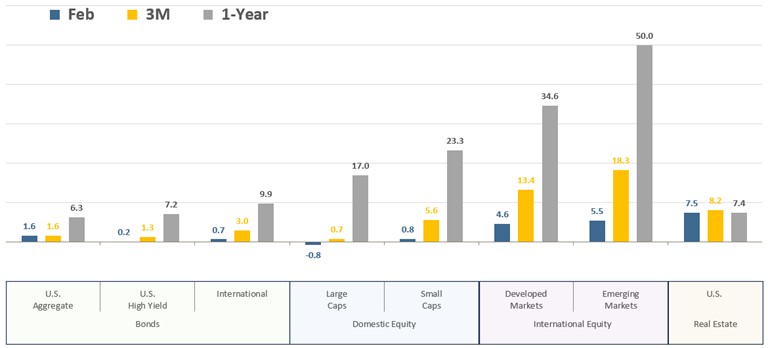
Despite these headwinds, October delivered another chapter in the bull market narrative. Large-cap growth stocks dominated, with mega-cap tech—the so-called “Magnificent Seven”—accounting for 36% of S&P 500 market capitalization. International equities joined the rally, with emerging markets posting gains north of 4%, outpacing U.S. benchmarks. Bonds also staged a quiet comeback as Treasury yields dipped below 4% mid-month before settling near 4.11%. Gold briefly stole the spotlight, crossing $4,000 per ounce amid safe-haven demand before retreating. These moves underscore a market leaning heavily on optimism, even as fundamentals flash mixed signals. [ccmg.com], [advancedmarkets.com]
What Should Investors Be Concerned About?
The concentration risk in equities is growing sharper. With tech giants driving index performance, any earnings disappointment could trigger outsized volatility. Elevated valuations—now in the top 1% of the past two decades—leave little margin for error. Add to this the lingering effects of tariffs, a cooling labor market, and geopolitical uncertainty, and the case for diversification becomes compelling. Investors should also watch liquidity conditions closely; the Fed’s pivot to rate cuts offers relief, but policy missteps or inflation surprises could unsettle markets. In short, the current rally is built on optimism—prudent risk management is the antidote. [gdswealth.com], [fiducienta…visors.com]
Sectors Gaining Momentum for 2026
Looking ahead, several sectors are positioning for leadership in 2026. Artificial Intelligence and automation remain at the forefront, with projected growth exceeding 20% as businesses double down on efficiency and innovation. Green energy is another structural pillar, supported by global decarbonization mandates and policy incentives, despite recent funding headwinds. Healthcare and biotechnology continue to attract capital, driven by breakthroughs in gene editing and personalized medicine. Meanwhile, infrastructure and industrial automation are emerging as quiet winners, fueled by smart-city initiatives and supply-chain resilience. For income seekers, dividend-rich sectors like utilities and industrials are expected to shine, with analysts forecasting 6% dividend growth across the S&P 500 next year. [247wallst.com], [smallworldfs.com], [sbankami.com]
The Year-End Imperative
As 2025 draws to a close, year-end financial planning takes center stage. Tax-loss harvesting, charitable giving strategies, and retirement contributions can all optimize your position before the calendar turns. For business owners, reviewing entity structures and succession plans is critical, especially in light of evolving tax policy. High-net-worth investors should revisit estate plans to ensure alignment with long-term goals. The market’s resilience this year offers opportunities—but also reminders that conditions can change quickly. A proactive approach now sets the stage for a confident start to 2026.