February closed out as one of the most consequential months in recent memory—marked by geopolitical escalation, a surprise weakening in the labor market, major shifts in stock market leadership, and a landmark Supreme Court ruling that injected new uncertainty into trade policy. For investors and business owners alike, the month highlighted why strategy, diversification, and disciplined planning matter more now than ever.
Market Overview: Rotation, Repricing, and Rising Caution
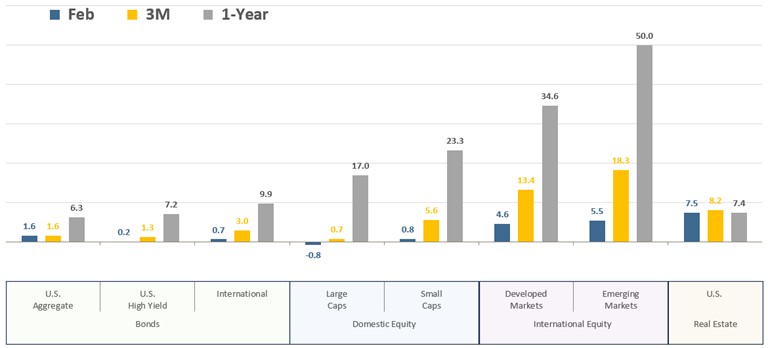
Financial markets entered February with strong momentum after nine months of gains, but sentiment shifted quickly as investors digested a combination of legal shocks, slowing economic data, and fears of escalating conflict in the Middle East. The S&P 500 slipped modestly, the Nasdaq saw its sharpest monthly decline in nearly a year, and the Dow managed only a marginal gain. Beneath the headline numbers, the market experienced a notable rotation: money moved out of mega‑cap tech and AI‑linked names and into more defensive or commodity‑sensitive sectors.
Utilities, Energy, and Materials were the standout winners of the month, benefiting from concerns over rising oil prices and broader uncertainty. Meanwhile, software, payments, and other information‑heavy industries faced steep declines as new AI capabilities triggered fears of business model disruption.
February Market Indicators:
- S&P 500: –0.8% to –1.0% [fidelity.com]
- Nasdaq Composite: –3.3% to –3.4% (worst month since March 2025) [energydigital.com]
- Dow Jones: +0.17% (10th straight monthly gain) [cardrates.com]
- Sector Strength: Utilities +9.9%, Energy +8.8%, Materials +8.3% [cardrates.com]
As volatility increases, the case for diversification, defensive positioning, and dividend‑oriented exposure becomes even stronger.
Economic Update: A Meaningful Labor Market Cooling
The February jobs report delivered one of the biggest surprises of the last two years. Employers unexpectedly shed 92,000 jobs, and the unemployment rate rose to 4.4%. Multiple sectors—including healthcare, manufacturing, information services, and federal government—saw declines, compounded by a major healthcare worker strike during the survey window.
The negative headline number was compounded by downward revisions to December and January, signaling that the cooling trend may be deeper than previously understood.
Labor Highlights:
- Payrolls: –92,000 in February [cbsnews.com]
- Unemployment: 4.4% (up from 4.1%) [ibanet.org]
- Sectors Weakening: Healthcare, information, manufacturing, federal employment [en.wikipedia.org]
For households and businesses, these shifts underscore an economy that is losing traction just as inflation remains sticky in core categories.
Inflation & the Oil Shock: Pressures Return
While inflation had been easing into year‑end, February introduced a major wildcard: energy. Even before hostilities escalated, global oil prices were rising due to supply constraints and geopolitical tension. Once U.S. and Israeli forces struck Iranian leadership and military infrastructure on February 28, oil markets reacted immediately.
Prices jumped 10–13% within days, and analysts warned that disruptions to the Strait of Hormuz—the pathway for roughly 20% of global oil flow—could push Brent crude toward $100 per barrel or more if shipping lanes remained compromised.
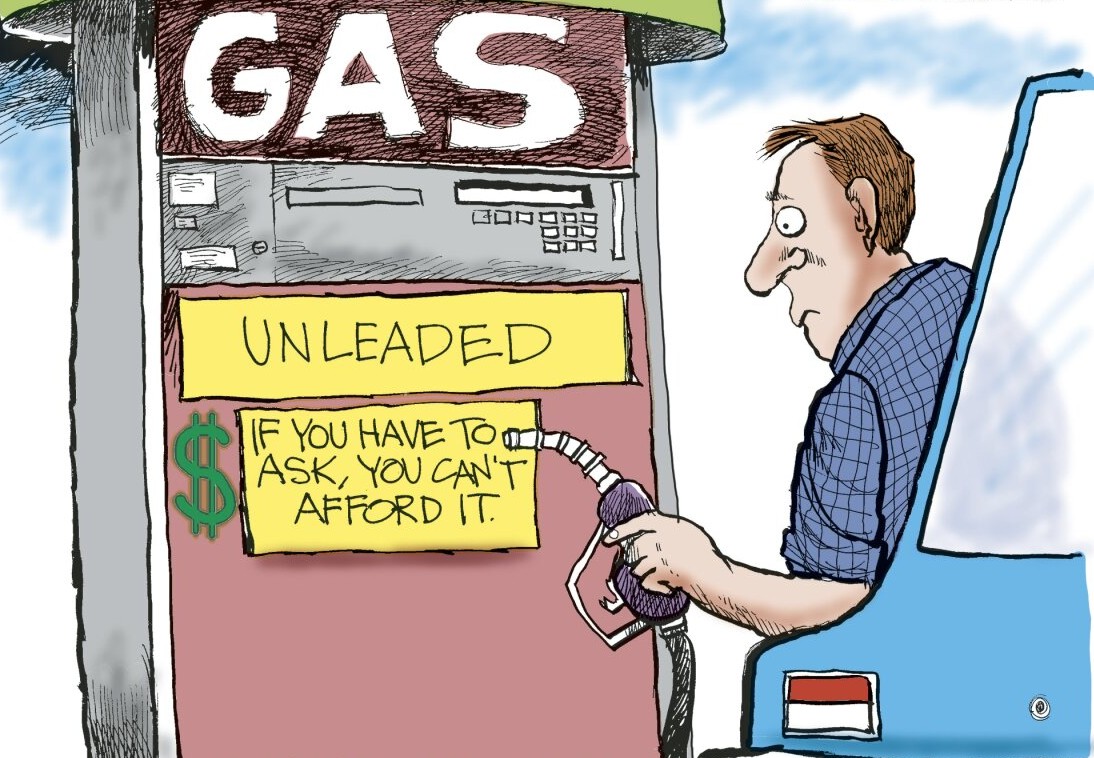
This sets the stage for renewed upward pressure on transportation, logistics, and consumer fuel prices in the coming weeks.
Oil & Energy Notes:
- Brent crude: jumped from ~$70 to $80+ following the strikes [modwm.com]
- WTI: surged to highs above $67 before spiking further in early March [bls.gov]
AI & Jobs: Disruption Without Collapse… for now
AI remained in the spotlight this month—but not for rallying markets. Instead, next‑generation “agentic AI” demonstrations shook investors, raising concerns about the future of software, payments, customer service, and even professional services.
However, while industries are bracing for transformation, labor research shows that AI’s employment impact is gradual, not sudden. Many employers plan to redeploy or upskill workers rather than replace them outright, though certain white‑collar roles are undeniably being redesigned.
Key Takeaways:
- BLS: AI disruption unfolds over years, not months [mba.org]
- WEF: 41% of employers foresee role reductions, but 77% plan on upskilling efforts over layoffs [housingwire.com]
For professionals, this is a moment to skill‑up, not panic.
Supreme Court Tariff Ruling: A Legal Earthquake
On February 20, the Supreme Court ruled 6–3 that the President lacked the authority to impose the sweeping tariffs enacted in 2025 under the International Emergency Economic Powers Act (IEEPA). The ruling effectively nullified the tariff regime that defined much of last year’s trade policy.
Within hours, the administration attempted to re‑impose a new 15% global tariff using a different statute (Section 122), adding even more uncertainty for importers, exporters, and consumers.
Implications:
- IEEPA tariffs invalidated; refund questions unresolved [butzel.com]
- New 15% global tariff announced, utilizing an alternative legal framework [hklaw.com]
- Global partners reacted with caution, delaying trade approvals and adopting a “wait‑and‑see” stance
Businesses now face a murky policy environment where tariff schedules could change rapidly and unpredictably.
Rising Delinquencies: Credit Stress Is Building
Although credit card delinquencies have not yet spiked dramatically, data from the New York Fed shows that serious delinquencies across credit categories are increasing, particularly among mortgages and in lower‑income zip codes.
Mortgage delinquencies rose meaningfully into year‑end, with FHA borrowers experiencing the sharpest strain. Credit card and auto debt also remain elevated versus historical norms as borrowing costs stay high.
Consumer Credit Snapshot:
- Mortgage delinquencies rising fastest in low‑income areas [cnbc.com]
- Overall mortgage delinquency rate reached 4.26% in Q4 2025 (FHA: 11.52%) [shrm.org]
- Credit card serious delinquencies trending higher from post‑pandemic lows [bls.gov]
These trends warrant close attention as the labor market weakens.
Why Financial Planning Matters More Than Ever
With markets rotating, inflation resurfacing, geopolitical risks rising, unemployment ticking up, and policy uncertainty at a high point, your financial plan becomes the stabilizing force. A strong plan enables you to:
- Maintain adequate liquidity
- Adjust portfolios toward high‑quality, risk‑aware positions
- Hedge inflation and energy shocks
- Navigate tax and policy volatility
- Protect your family and business via updated estate documents
In uncertain environments, planning transforms chaos into clarity.
New Services Now Available for Business Owners
We are excited to introduce two new offerings designed to strengthen your financial operations:
1. Credit Card Rewards Optimization + Bookkeeping Support
For those who are looking to strengthen their card usage, we have launched a proprietary tool that analyzes spending patterns to suggest ways you can use your cards to maximize cash‑back and travel benefits. Additionally, we are now offering limited monthly bookkeeping and payroll services to qualified clients.
2. Trust & Will Partnership
Through our partnership with Trust&Wills.com, we can assist clients with drafting wills and trusts with ease, ensuring that estate planning finally aligns with financial planning.
These services are designed to help you keep more of what you earn, reduce overwhelm, and build long‑term resilience into your personal and business finances.
Footnotes (Sources)
- Market performance & sector moves: Winthrop Wealth (Mar 2, 2026), Cetera (Mar 2, 2026), Marks Group (Mar 3, 2026) [fidelity.com], [energydigital.com], [cardrates.com]
- Labor data: BLS Employment Situation (Feb 2026), Economic Times summary (Mar 6, 2026) [cbsnews.com], [en.wikipedia.org]
- Oil & Middle East conflict: IEA Oil Market Report (Feb 2026), Economic Impact of 2026 Iran War (Wikipedia), FinancialContent (Feb 27, 2026) [get.ycharts.com], [modwm.com], [bls.gov]
- AI & employment: BLS Monthly Labor Review (Feb 2025), CNBC on WEF report (Feb 26, 2025) [mba.org], [housingwire.com]
- Tariffs ruling: SCOTUSblog (Feb 20, 2026), CNBC (Feb 23, 2026) [butzel.com], [hklaw.com]
- Consumer credit & delinquencies: NY Fed Q4‑2025 Household Debt (Feb 10, 2026), Liberty Street Economics (Feb 10, 2026), MBA (Feb 12, 2026) [bls.gov], [cnbc.com], [shrm.org]